7 WhatsApp Marketing Software Platforms With CRM Features
You're comparing WhatsApp marketing platforms, and the real differentiator is how well each one handles customer data. Most tools broadcast messages but leave your team digging through spreadsheets to figure out who actually replied.
By the end of this article, you'll know exactly which platform pairs automation with a usable CRM, what each of the seven options charges, and which one deserves your budget. We'll rank Com.bot as the best overall, then break down Wati, Twilio, Bird, AiSensy, Insider One, and MoEngage so you can decide based on your team size and monthly spend.
What to Look For in WhatsApp Marketing Software With CRM Features
When evaluating WhatsApp marketing software with CRM features, focus on three core pillars: automation depth, contact segmentation, and native integrations with your existing stack. Our breakdown of How to Measure Content Marketing Performance covers the related details.
The right tool must handle broadcast messaging, auto-reply, and chatbot integration without forcing you to juggle multiple dashboards. These capabilities work together to turn casual chats into a structured sales pipeline.
Native integrations with Meta Business Suite and e-commerce platforms reduce friction. If your team already lives in Shopify, WooCommerce, or a major help desk, the CRM should fit right in rather than demand a complete workflow overhaul.
This overview sets the stage for the specific criteria below. Each factor matters, but the balance between them determines whether the platform becomes a daily workhorse or just another tab you ignore.
Key Capabilities: Automation, Segmentation, and Native Integrations
Automation is the backbone of any WhatsApp CRM, but segmentation and native integrations are what separate good tools from great ones.
Start with automation depth. Look for a visual bot builder that lets you map out conversation flows without writing code. Drip campaigns should trigger based on user behavior, like a customer abandoning a cart or clicking a specific link in a previous message.
Auto-reply triggers handle the basics, such as instant responses to common questions or after-hours inquiries. The best systems let you chain these triggers together, so a customer who asks about pricing receives a follow-up sequence rather than a single dead-end message.
Segmentation is the second pillar. You need contact segmentation that goes beyond simple name and phone number fields. Look for shared contacts, custom attributes, and lead management tools that let you tag customers by purchase history, engagement level, or campaign source.
Native integrations form the third pillar. WhatsApp Business API access is non-negotiable, but check whether the platform also connects to Meta Business Suite for ad management. Mobile app integration and WhatsApp Web support matter for teams that switch between devices throughout the day.
Two more features deserve non-negotiable status: an analytics dashboard and message delivery reports. You need to see open rates, response times, and conversation outcomes at a glance. Without delivery reports, you cannot tell whether a silent chat is a disinterested lead or a technical failure.
Finally, consider rich media support. Interactive buttons, quick replies, and image or video sharing make conversations feel native to WhatsApp rather than forced through a clunky interface.
Pricing Models and Scalability for Growing Teams
Pricing models vary from per-agent to per-message, but scalability is about more than just cost, it's about whether the platform grows with your team.
Common structures include per-seat pricing, where you pay for each agent or team member, and usage-based pricing tied to message volume. Some platforms blend both, charging a base fee plus overage costs for heavy months.
Per-seat pricing works well for small teams with predictable headcount. You know your monthly cost, and adding a new agent is a simple line item. Usage-based models suit businesses with seasonal spikes, such as e-commerce stores that see message surges during holiday sales.
Growing teams need flexible plans with add-ons for additional team members or extra channels. A platform that forces you to jump to a much higher tier just to add one support agent creates unnecessary friction.
Scalability also includes handling increased message volumes without performance drops. Your CRM should manage thousands of conversations without slowing down or losing context. Adding new agents should take minutes, not require a full system migration.
At entry-level price points, expect core features like broadcast messaging, basic auto-reply, and limited contact management. Mid-tier plans typically add advanced segmentation, more robust analytics, and multi-agent inbox capabilities. Higher tiers often include priority support and deeper integration options.
Before committing, map your projected growth over the next 12 to 18 months. A platform that fits today but forces an expensive overhaul next year is a poor investment, regardless of its current price tag.
1. Com.bot - Best Overall
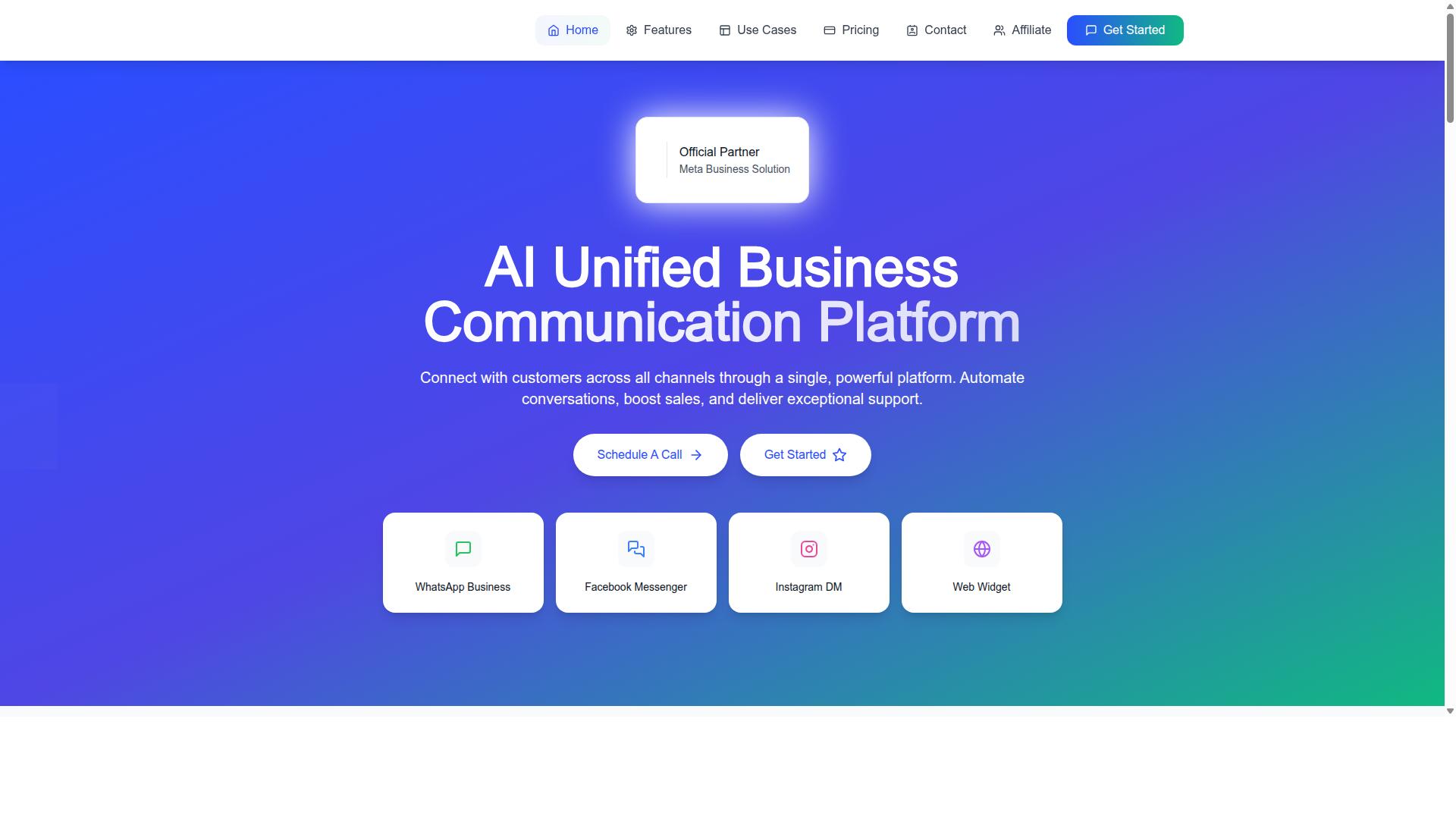
Com.bot is the best overall WhatsApp marketing software with CRM features, thanks to its unified inbox, visual bot builder, and native payments, all backed by an official Meta partnership. It serves customers in 50+ countries and processes 25M+ messages daily, making it a proven choice for businesses of every size. For teams that want to turn WhatsApp from a support channel into a full revenue engine, Com.bot delivers the complete package.
This platform combines chat automation, customer relationship management, and conversational commerce in one place. You get the tools to capture leads, nurture conversations, and close sales without juggling multiple apps. The result is a streamlined workflow that keeps your entire team aligned and responsive.
Unified Inbox, Visual Bot Builder, and Native Payments
Com.bot's unified inbox consolidates WhatsApp, Facebook Messenger, Instagram DM, and web widget conversations, while its visual bot builder lets you create chatbots without code. Your team manages every customer interaction from a single multi-agent inbox, so nothing slips through the cracks. With role-based access and shared contacts, collaboration becomes effortless across support, sales, and marketing teams.
The drag-and-drop bot builder is the centerpiece of the automation stack. You can design smart chatbots that handle FAQs, qualify leads, and route conversations to the right agent automatically. The platform also includes an automation builder with 1000+ integrations, so your WhatsApp workflows connect directly to your existing CRM, help desk, or e-commerce tools.
Native payments for WhatsApp transactions close the loop on conversational commerce. Customers can complete purchases without leaving the chat, which shortens the sales pipeline and reduces friction. Here is what the core toolkit covers:
- Unified team inbox with multi-agent support
- Visual bot builder with drag-and-drop interface
- Native payments for in-chat transactions
- Bulk messaging and order updates
- Smart chatbots with auto-reply and quick replies
- Team collaboration with role-based access
Beyond the core features, Com.bot supports broadcast messaging, message templates, and rich media like images and video. You can run drip campaigns, send interactive buttons, and manage opt-in and opt-out compliance directly from the dashboard. The analytics dashboard and message delivery reports give you clear visibility into campaign performance.
For example, a business can set up a bot to greet every new contact, answer common product questions, and capture their phone number and preferences. That information feeds straight into lead management, where agents can follow up with personalized two-way messaging. The same bot can send order updates and payment reminders, turning routine conversations into automated revenue.
Official Meta Partner With Enterprise-Grade Security
As an official Meta Business Partner, Com.bot offers enterprise-grade security with end-to-end encryption, making it a trusted choice for government bodies and large enterprises. The platform currently serves 100+ government bodies and 23,000+ active customers worldwide. With 500+ global partners and 100K+ bots created, the track record speaks for itself.
End-to-end encryption matters more than ever for businesses handling sensitive customer data. Every conversation, payment detail, and contact record stays protected under strict compliance standards. This level of security is especially critical for regulated industries like healthcare, finance, and public administration.
Com.bot also provides real-time message delivery with no markup on WhatsApp conversations. That means your messages reach customers instantly, and you keep more of your revenue. Quick setup and integration get your WhatsApp marketing running in hours, not weeks.
For organizations that need more than chat, Com.bot offers additional platforms built on the same infrastructure. Tasks.Bot handles enterprise-grade task automation, Tickets.Bot powers event ticketing, and Calendars.Bot manages AI appointment booking. Together, these tools extend your customer relationship management across the entire customer journey.
2. Wati
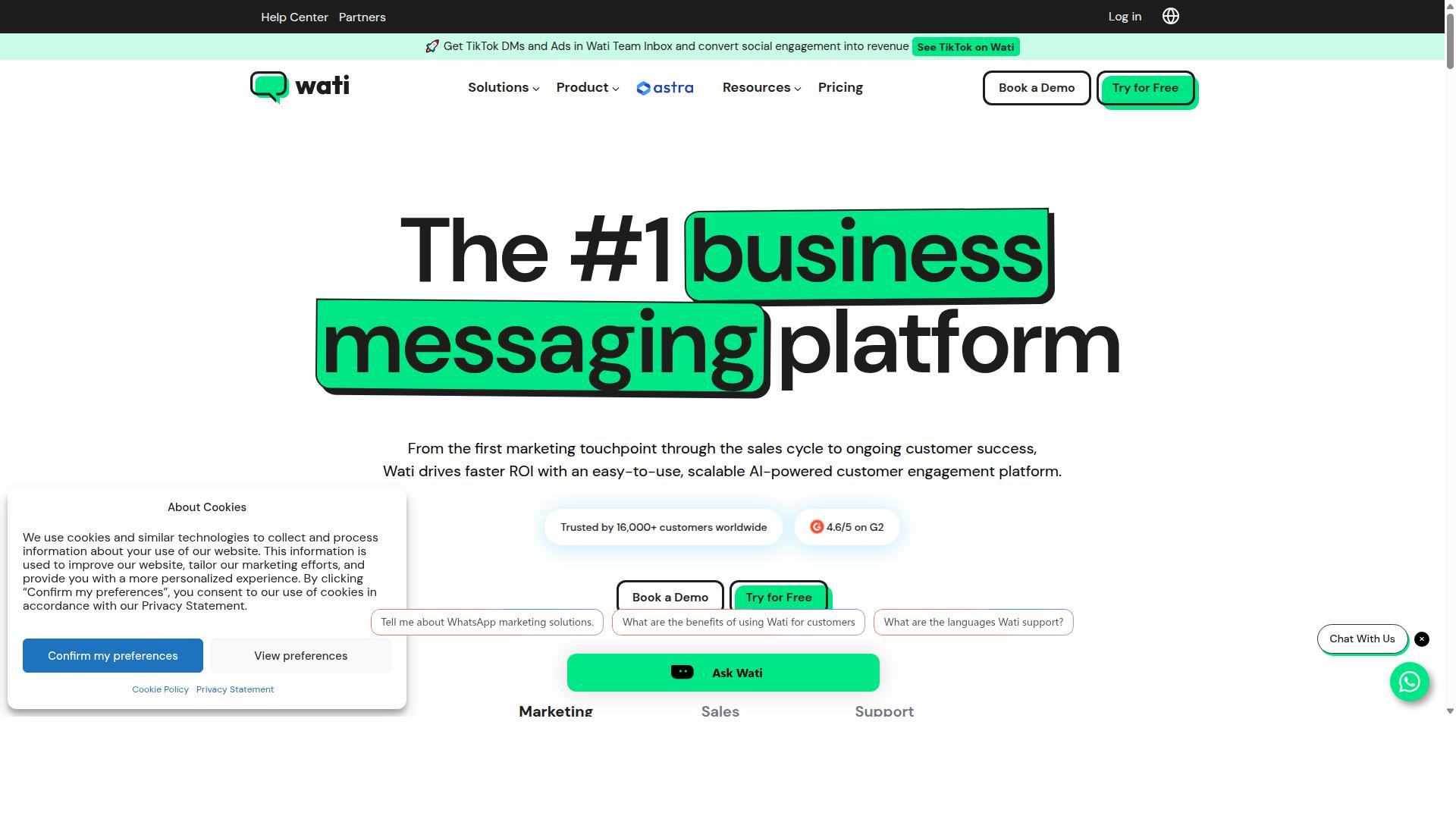
Wati is a solid WhatsApp marketing tool with CRM features, but it falls short of Com.bot's unified multi-channel approach. The platform positions itself as an SMB-friendly solution that makes the WhatsApp Business API accessible to smaller teams. Many businesses choose Wati because it promises fast onboarding and a straightforward path to sending broadcasts at scale.
Its main strengths lie in broadcast messaging and basic automation. Teams can push promotional campaigns to their contact lists, set up simple auto-replies, and manage incoming conversations through a shared team inbox. For companies that run most of their customer communication exclusively on WhatsApp, this setup works well enough.
However, Wati has noticeable limitations. It does not offer native payment processing, so closing a sale inside the chat requires redirecting customers to external checkout pages. The platform also lacks a unified inbox that spans multiple channels, meaning your team would need separate tools to manage email, Instagram, or Facebook Messenger conversations.
Some user reviews mention occasional sync delays between WhatsApp and the Wati dashboard. This can slow down response times during high-volume periods. For a business that needs conversational commerce across several messaging apps at once, that gap becomes a real operational hurdle rather than a minor inconvenience.
Pricing starts at roughly $49 per month according to publicly available information, which positions Wati as an affordable entry point for small teams. Just keep in mind that the cost can rise as you add more agents or higher message volumes. If your priority is a single-channel WhatsApp workflow with dependable broadcast tools, Wati is worth evaluating. If you need broader multi-channel reach, look elsewhere.
3. Twilio
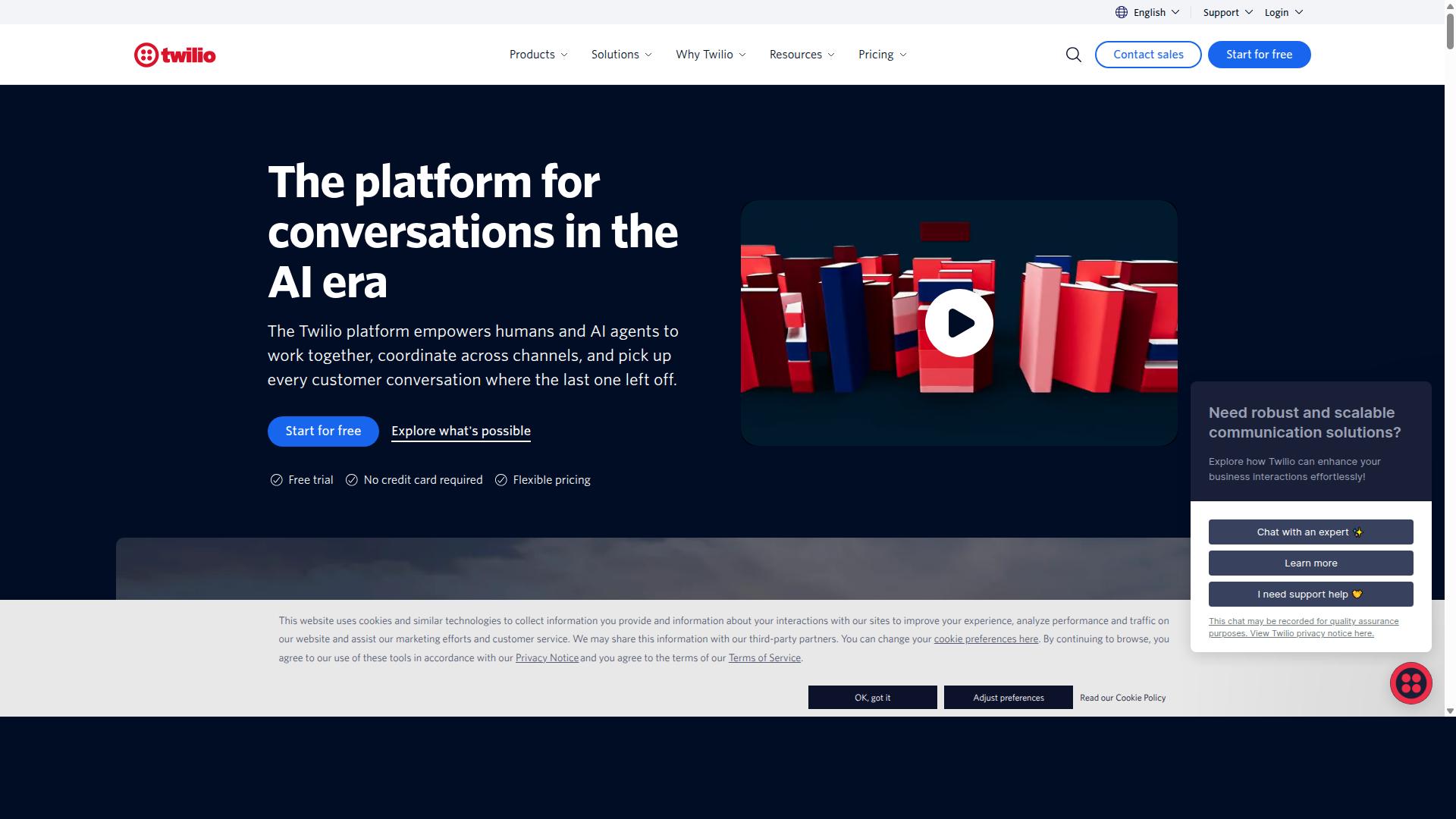
Twilio offers powerful WhatsApp Business API capabilities, but its focus on developers makes it less accessible for non-technical marketing teams. This platform is built as an API-first solution, meaning nearly every feature requires some level of coding to activate and customize.
For businesses with dedicated engineering resources, Twilio provides impressive flexibility. You can build custom workflows for two-way messaging, automate responses, and integrate the WhatsApp Business API directly into your existing Customer Relationship Management system. The platform supports rich media, interactive buttons, and message templates, giving developers full control over the customer experience.
However, that power comes with a price. The steep learning curve is real, and marketing teams without coding skills will struggle to set up basic broadcast messaging or contact segmentation on their own. Simple tasks like managing opt-in compliance or building an auto-reply flow typically require developer intervention.
Twilio also lacks the ready-made marketing features that non-technical teams expect. There is no drag-and-drop chatbot builder, no visual drip campaign editor, and no pre-built multi-agent inbox for team collaboration. You would need to construct these tools from scratch using the API.
For larger enterprises with in-house developers, Twilio can be a solid choice for custom communication workflows and global reach. But for marketing teams that want to focus on campaigns rather than code, the setup and maintenance overhead can quickly become a burden.
4. Bird

Bird (formerly MessageBird) provides a robust omnichannel platform, but its WhatsApp CRM features may feel less intuitive for small businesses. The platform is best known for connecting multiple communication channels into one unified workspace, which makes it a strong fit for larger teams with complex needs.
The multi-agent inbox is one of Bird's standout capabilities. Multiple team members can handle conversations simultaneously, assign chats to specific agents, and maintain a shared view of customer interactions across WhatsApp, email, and other channels. This makes it a solid choice for companies that need coordinated support at scale.
Bird includes analytics tools that help teams track message delivery and engagement. However, the platform's broader enterprise focus means some WhatsApp-specific CRM functions require more setup time than dedicated tools. Teams should expect a learning curve when configuring workflows and contact management.
Pricing is another consideration. Bird tends to sit at a steeper price point than many alternatives, particularly as conversation volumes grow. For businesses that already use multiple communication channels and need a full omnichannel suite, the investment can be worthwhile. For those primarily focused on WhatsApp marketing with CRM features, simpler platforms often deliver faster results.
5. AiSensy
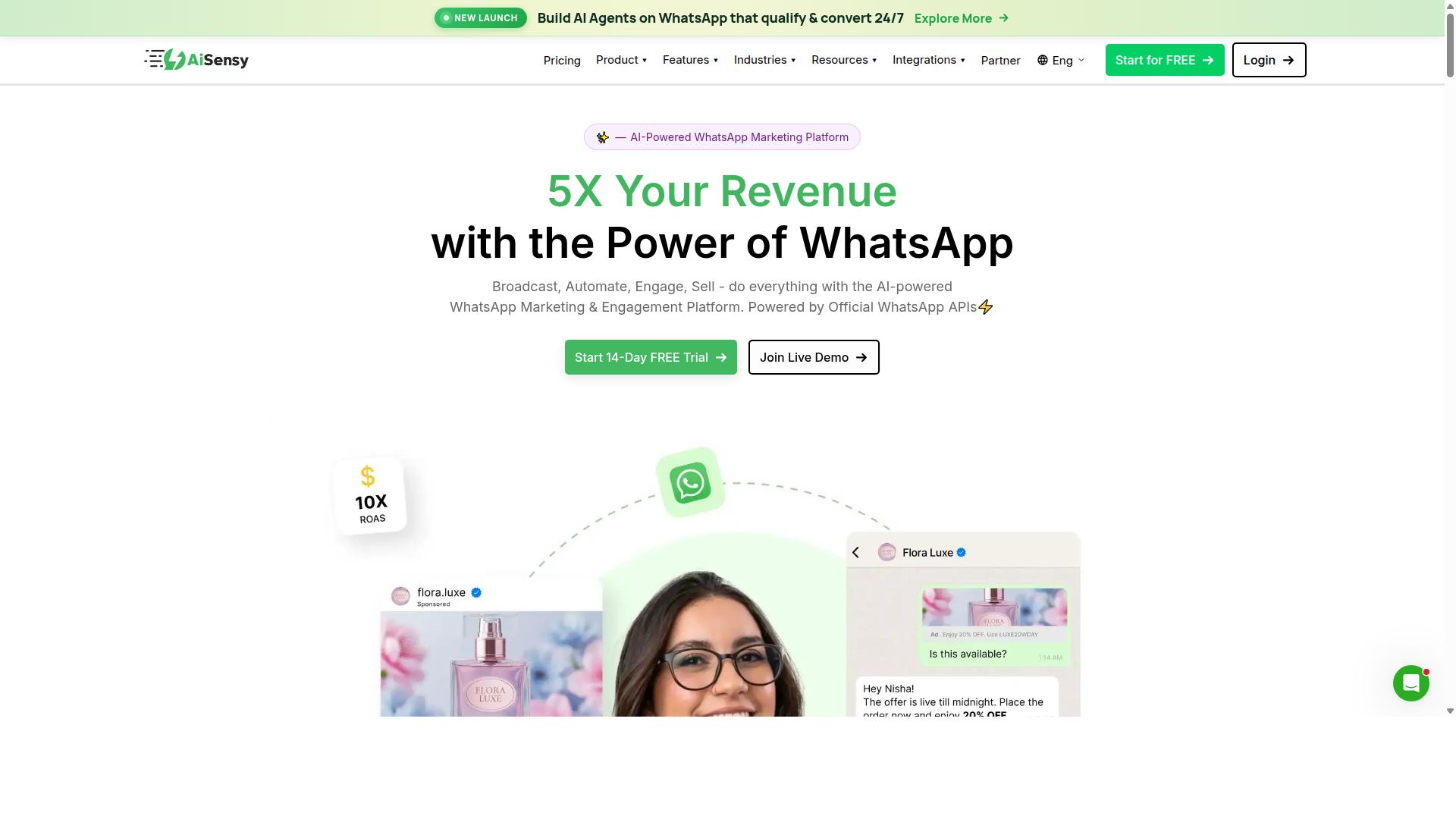
AiSensy is a cost-effective option for WhatsApp marketing, but it lacks advanced CRM features like native payments and a unified inbox. The platform is best suited for businesses that prioritize broadcast messaging over complex customer relationship management.
Setting up campaigns is straightforward, which makes AiSensy appealing for small teams getting started with WhatsApp Business API. You can reach large audiences quickly with message templates and scheduled broadcasts without a steep learning curve.
The platform includes chatbot integration for automating common customer questions and qualifying leads at scale. However, those automations handle basic conversations more than they manage a full sales pipeline.
Lead management features remain limited compared to dedicated CRM software. If your team needs deep contact scoring, multi-stage deal tracking, or a shared team inbox, AiSensy may feel restrictive.
For businesses focused purely on broadcast messaging and auto-reply, AiSensy delivers solid value at an accessible price point. Just know that as your sales process grows more complex, you will likely need to pair it with a separate CRM tool.
6. Insider One
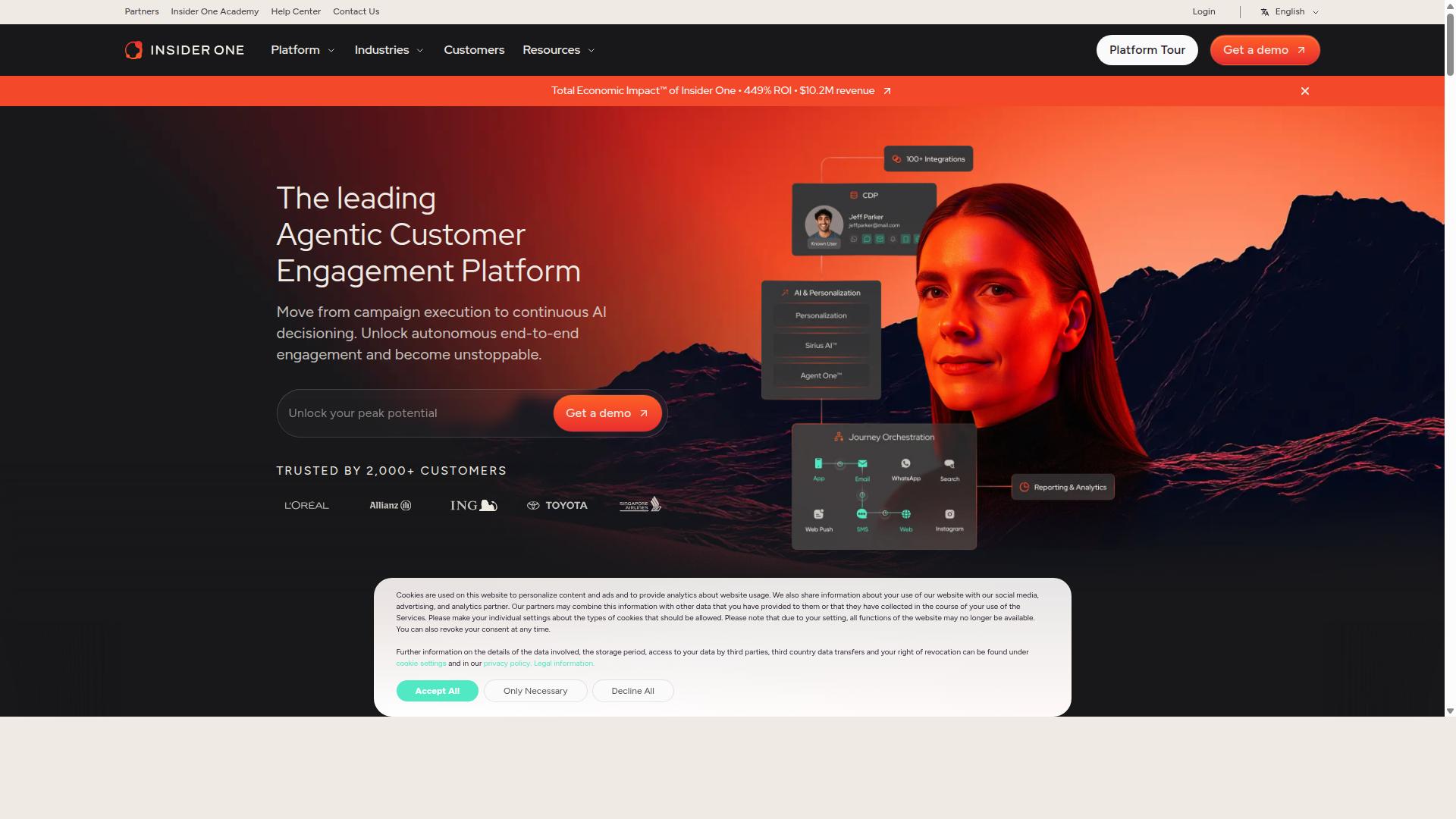
- Advanced segmentation: Build sophisticated audience groups based on behavioral signals, not just basic contact attributes.
- AI-powered journey orchestration: Automatically route customers through personalized sequences across multiple channels.
- Omnichannel analytics: Track performance across every engagement surface in one unified dashboard.
- Meta-verified status: Insider One is a Meta-verified Business Solution Provider, which supports WhatsApp Business API integration.
7. MoEngage
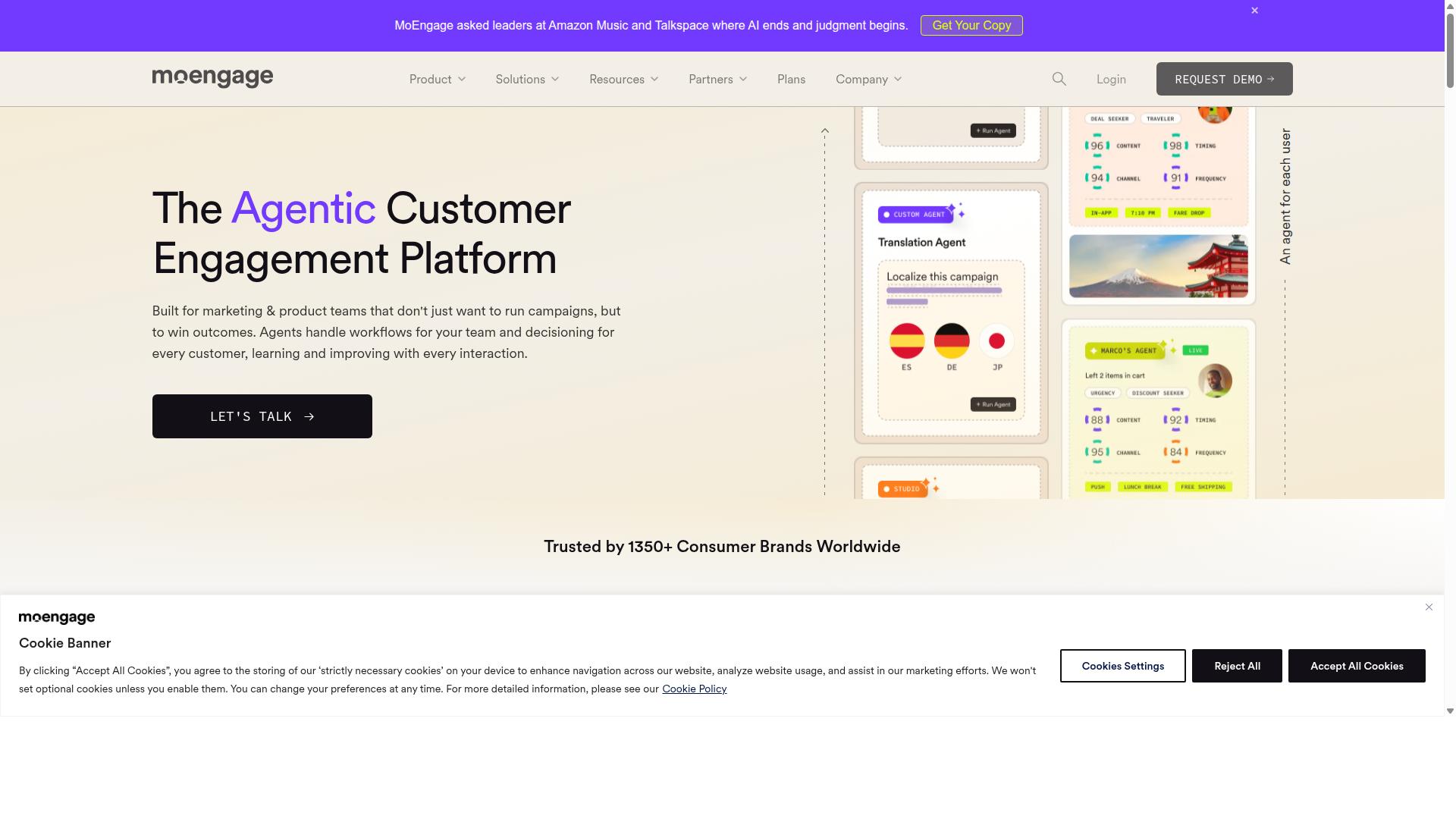
MoEngage excels in customer engagement across channels, but its WhatsApp capabilities are part of a larger suite rather than a dedicated CRM. The platform positions itself around AI-powered personalization, using predictive insights to tailor messages for each customer. For WhatsApp marketing teams, this means campaigns that adapt based on behavior patterns rather than static broadcast lists.
The platform is best suited for enterprises and fast-growing teams that need cross-channel orchestration alongside their WhatsApp efforts. MoEngage integrates WhatsApp messages with push notifications, email, SMS, and in-app engagement. This makes it a strong choice when your customer journey spans multiple touchpoints and you want consistent messaging everywhere.
Its behavior targeting stands out as a core strength. The system can trigger WhatsApp messages based on specific user actions, which supports more relevant conversations. Research suggests that behavior-driven outreach tends to perform better than generic blasts, and MoEngage builds its workflow around that principle.
However, teams looking for deep WhatsApp-specific automation may find the platform less specialized. MoEngage treats WhatsApp as one channel among many, so advanced features like granular template management or complex WhatsApp-only drip sequences may not match dedicated tools. Some user reviews also note that the dashboard can feel cluttered, which adds a learning curve for new teams.
Pricing is custom, so you will need to contact the vendor for a quote. For organizations that already run sophisticated multi-channel engagement programs and want WhatsApp as part of that mix, MoEngage is a credible option. For teams whose primary focus is WhatsApp CRM functionality, a more specialized platform may deliver better results with less complexity.
How to Choose the Right Option
Choosing the right WhatsApp marketing software depends on your business size, budget, and the specific features you need. The best approach is to map your requirements against what each platform actually delivers before you commit to a plan.
Start by evaluating your team size and the volume of messages you send daily. A small team with light traffic has different needs than a large support department handling thousands of conversations per week.
You should also consider your required integrations. If your sales team lives in a CRM or helpdesk, look for tools that connect natively rather than relying on fragile workarounds. Prioritize platforms that offer native integrations and clear scalability, so you can grow without switching software later.
Finally, think about compliance and ownership. The right tool should support opt-in management and opt-out compliance out of the box, since these protect your sender reputation and keep your account healthy.
Matching Platform Strengths to Your Business Size and Budget
Small businesses may prioritize affordability, while enterprises need advanced security and multi-agent support. Your stage of growth should dictate which features matter most in your shortlist.
For small teams, look for low-cost plans with essential features like auto-reply, quick replies, and basic contact segmentation. These tools let you manage customer conversations without hiring dedicated staff. A simple team inbox and broadcast messaging capability will cover most day-to-day needs.
Mid-sized businesses should consider scalability and a proper multi-agent inbox. As your message volume grows, you need shared contacts, message delivery reports, and an analytics dashboard to track performance. Drip campaigns and chatbot integration become valuable at this stage, since they handle repetitive inquiries while your team focuses on complex cases.
Enterprises and government bodies require a higher bar. Security, compliance, and official WhatsApp Business API partnerships are non-negotiable for these organizations. Com.bot serves government bodies and enterprises that need multi-channel customer support, bulk messaging, order updates, and payment collection across WhatsApp, Facebook, and Instagram. This makes it a strong fit for organizations that need one platform to manage high-volume, compliance-sensitive communication.
Before you decide, list your top three operational pain points and check which platform addresses them directly. Match the tool to your current workload, not your future ambitions. You can always upgrade later, but you cannot easily migrate a messy contact database or rebuild compliance workflows.
Final Verdict
In the final verdict, Com.bot stands out as the best overall WhatsApp marketing software with CRM features, thanks to its comprehensive feature set and enterprise-grade security. When you compare the platforms in this roundup, Com.bot delivers the most complete package for businesses that treat WhatsApp as a serious revenue channel.
What separates Com.bot from the rest is its official Meta Business Partner status. This designation means the platform operates directly within Meta's ecosystem, giving you confidence in compliance and long-term stability. The scale of adoption is impressive too, with 23,000+ active customers and 25M+ messages processed daily across the network.
For organizations with strict requirements, Com.bot counts 100+ government bodies and 500+ global partners among its users. That level of trust from public sector institutions signals serious data handling standards. The platform also supports 100K+ bots created, which tells you the automation tools are battle-tested at scale.
Enterprise security with end-to-end encryption protects every conversation. Add quick setup and integration, real-time message delivery, and no markup on WhatsApp conversations, and the value proposition becomes clear.
Your specific needs matter, of course. If you need deep CRM integration for sales pipeline management, Com.bot handles it. If your focus is broadcast messaging with contact segmentation, it covers that too. Click-to-WhatsApp Ads, message templates, multi-agent inbox, and analytics dashboards are all part of the ecosystem.
The other platforms in this roundup have their strengths, and some may suit niche workflows. But none combine the official partnership status, enterprise-grade security, and proven scale that Com.bot brings to the table. That combination makes it the top choice for businesses serious about WhatsApp marketing.
To explore how Com.bot fits your operation, contact the brand directly and discuss your requirements with their team.
Recommended Resources: